India as a Linguistic Area
A linguistic area refers to a geographical area in which, due to borrowing and language contact, languages of a region come to share certain structural or lexical features as a result of their close proximity. The elements shared by these languages are called areal features, and are acquired rather than inherited. Languages are generally classified typologically or genetically; the genetic classification of languages points to the existence of language families, wherein languages can be grouped based on their shared inheritance from a common ancestor. However, a linguistic area is a result of the diffusion of linguistic traits over genetic boundaries so that genetically dissimilar languages or dialects can be grouped together due to common features that they have acquired as a result of contact.
According to a recent census, India has about 121 languages belonging to four major language families:
- Indo-Aryan – Marathi, Bangla, Hindi etc.
- Dravidian – Telugu, Tamil etc.
- Austro-Asiatic – Mundari, Santhali etc.
- Tibeto-Burman – Meitei (spoken in Manipur), Gongduk etc.
Each of these families have a few defining features, for instance, Indo-Aryan languages utilize aspirated consonants while Dravidian languages don’t. Austro-Asiatic languages use glottal stops and circumfixation, and Tibeto-Burman languages are highly tonal.
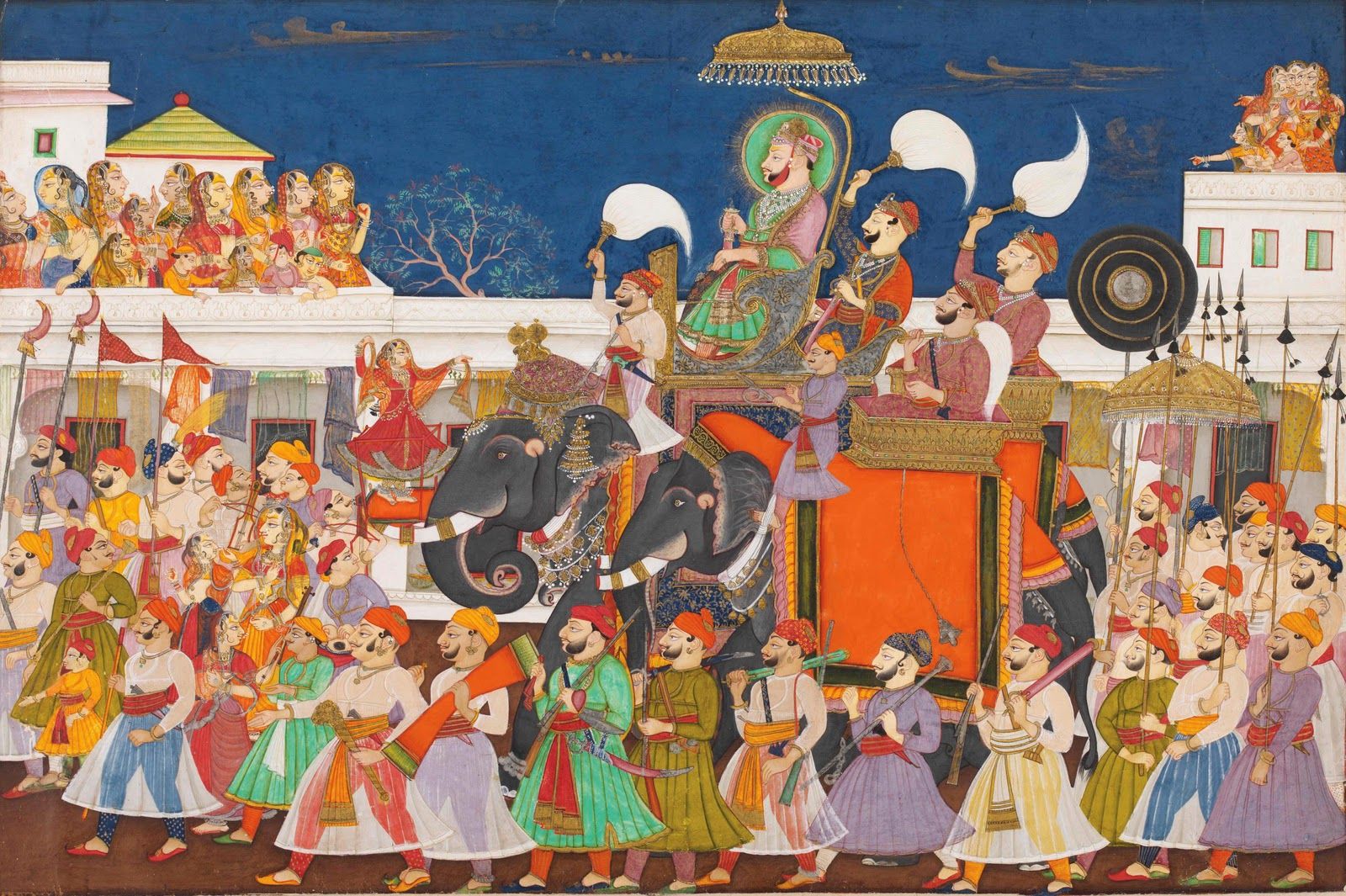
These four language families in India have influenced each other over the course of almost 3000 years through political and social contact. Over time, their coexistence has given rise to an underlying pan-Indian linguistic pattern that can be attributed to the Indian Linguistic Area. Linguistic and racial purity is a myth today - the mixing of population through invasions, inter-marriages, trade and migration led to the diffusion of languages in each other. In the olden times, travelers and merchants from all over the subcontinent would interact with others in marketplaces, royal courts, and caravanserais. People speaking different dialects and languages could be found working in the same factory or farm. On the battlefield, soldiers would speak indigenous languages while their superiors would speak different ones. Every major movement of people would result in the movement of their language too; as sultanates, kingdoms and administrations expanded their territories or shifted their capitals, a linguistic assimilation was inevitable. In fact, there is proof of the intermixing of Dravidian and Indo-Aryan languages through the pockets of Dravidian-based languages like Brahui and Kurukh in remote areas of Pakistan and interspersed areas of North India.
Murray B. Emeneau, a prominent American linguist wrote a seminal article called ‘India as a Linguistic Area’ where he defined a linguistic area as ‘an area which includes languages belonging to more than one family but showing traits in common’. In the paper, Emeneau observed that the subcontinent’s Dravidian and Indo-Aryan languages shared a number of areal features including retroflex consonants, echo words, subject–object–verb word order, discourse markers, and the quotative, which came about as the result of extensive borrowing and diffusion. He noted that ‘the end result of the borrowings is that the languages of the two families, Indo-Aryan and Dravidian, seem in many respects more akin to one another than Indo-Aryan does to the other Indo-European languages’. Over centuries, the four language families had converged structurally, such that the languages became similar at an abstractive level, but still maintained their identity with their lexicon.
For instance, in the border village of Kupwar, people speak 3 languages: Kannada, Urdu and Marathi (of which the former is Dravidian and the other two are Indo-Aryan). Most individuals are trilingual in the area, and constantly switch back and forth among these languages. Over time, the varieties have grammatically converged, with the 3 varieties having almost the same word order and morphology, while maintaining a distinct vocabulary.
Structural and Lexical Similarities
The most common way that languages influence each other is the exchange of words. The exchange is not unidirectional and Sanskrit (Indo-Aryan) words are often found in languages belonging to other languages families of India, and vice versa.
- Sanskrit words in Malayalam like sneham (സ്നേഹം) from sneh (स्नेह) and ahaṅkāram (അഹങ്കാരം) from ahaṅkār (अहङ्कारः)
- The Tamil word ulagu (உலகு) became log (लोग्) in Sanskrit, logamu in Telugu and lok in Hindi.
Within the same language family, vocabulary is often similar. For instance, ‘name’ is written as pēru in Telugu, pēr in Malayalam and peyar in Tamil.
Similarly, several phonetic traits are common to Indian languages, like the hard retroflex ‘t-’ from tamatar (टमाटर), or voiceless aspirated sounds like ‘kh-’ and ‘ph-’, from khana (खाना) and phool (फूल). These sounds are so widespread that they are even found in isolated languages like Andamanese.
The influence goes deeper than this, and features related to the morphology and grammar of these language families are exchanged. For instance, Nepal Bhasa (Newar) is a Sino-Tibetan language distantly related to Chinese but owing to its contact with neighbouring Indo-Iranian languages, has developed traits like noun inflection and verb tenses that are typical of Indo-European languages, but rare in Sino-Tibetan.
Irrespective of family, most Indian languages follow a Subject-Object-Verb (SOV) typological structure. Consider the sentence “The boy throws the ball”.
- Malayalam: kuṭṭi pant eṟiyunnu (കുട്ടി പന്ത് എറിയുന്നു)
- Hindi: ladaka gend phenkata hai (लड़का गेंद फेंकता है)
- Nepali: kēṭālē bala phyālcha (केटाले बल फ्याल्छ)
Here, the subject (the boy / kuṭṭi) is followed by the object (the ball / pant) and ends with the verb (throws / eṟiyunnu). However, this is not always the case. Tibeto-Burman languages like Karenic and Baic have SVO (subject–verb–object) word order, like Chinese.
Most Indian languages are also morphologically rich, which means they have a relatively free word order. Unlike the syntax-heavy English, Indian languages allows ‘word chunks’ to move, as the morphological elements carry a lot of grammatical information. Consider the sentence “The girl hit the boy”. If we switch the subject and object, we get “The boy hit the girl”, which doesn’t mean the same. However, in Hindi, the same sentence “ladki ne ladke ko mara” can be rewritten as “ladke ko ladki ne mara” and the meaning would remain the same.
Another common feature is the pro-drop, where redundant pronouns (pleonastic expletives) are not used. The sentence “It is raining” contains the pronoun ‘it’ which is semantically vacuous. In Tamil, the same sentence would be written as maḻai peykiṟatu (மழை பெய்கிறது) without a pronoun.
Additionally, most languages are left-branching (with respect to their parse tree) and use postpositions. In Burmese, the phrase “over the table” translates to hcarr pwal kyaw (စားပွဲကျော်) where kyaw is the preposition.
Reduplication is a feature found in the Indian Linguistic Area. By repeating the base word, we put more emphasis, intensify, imply plurality etc. This can be done on nouns, verbs, adverbs or even adjectives.
- Hindi: ghar-ghar means ‘every house’
- Tamil: chinna-chinna means ‘little’
In Indian languages, the auxiliary verb follows the main verb. For the sentence “You may go”, the auxiliary ‘may’ is represented in Hindi by ‘sakte’ and in Malayalam by the ending inflection ‘-am’.
- Hindi: tum ja sakte ho
- Malayalam: ninakk pokām
Furthermore, time adverbials precede place adverbials. Consider Main tumhe kal institute mein milungi. This sentence can be translated to “I will meet you in the institute tomorrow”. While the adverbial chunks can be interchanged, this is the standard order of saying it: kal/’tomorrow’ is said first, and followed by the place ‘institute’. These adverbials are also used in the descending order, In the sentence Mujhe India mein Hyderabad ke IIIT ke gate par milo, the order in which the adverbials occur starts from the largest (‘India’), followed by ‘Hyderabad’, and keeps getting more specific or smaller as the sentence progresses.
The Indian Linguistic Area has many more shared grammatical features, like the usage of the conjunctive participle as a discourse connector, echo words, following a relative clause + noun + postposition order etc. The coexistence of all these language families for centuries while changing each other gradually as a result of their contact is a reminder of the evolutionary nature of language and the social factors that result in its transformation.
References:
- India as a Linguistic Area, M. B. Emeneau
- Language: Its Structure and Use, Edward Finegan
- Tibeto-Burman languages
Comments